Cultural Differences: Equity and Technology
Competency 5.02
Kristin Hokanson
The term "digital divide" has traditionally been used to describe the gap, inequalities or social exclusion, between those who have access to the new services of the information society, computers and the Internet, and those who do not. In a study as recent as September, 2006, it was found that many more white children use the internet than do Hispanic and black students (Feller, 2006). We have hundreds of TV channels, not to mention streaming sources of media, new and improved computers and peripherals, cell phones that allow you to send your voice and pictures across the airwaves… In a global world and digital society where open source software and $100 laptops are pushing technology into every aspect of our lives, we need to be more cognizant of the continuum between the haves and have-nots.
Even though technology appears to be prevalent in all of society, there continues to be a digital divide among children of different cultures. In Becker’s 1992 study it was found that “…U.S. schools in poor districts or schools with a majority-black student enrollment have 10 to 12 percent fewer computers than other schools….[H]igh school vocational classes in those schools are less likely to involve computer use….[E]lementary and middle school teachers in poor-district/majority-black schools focus more student effort on math facts and language arts mechanics and spend less time teaching students word processing or how computers work. “ (Becker, 1992) There was not much change over the next 6 years. Among households at the same income levels, studies found that African Americans are about three years, and Hispanics are about four years behind, white non-Hispanics in terms of their likelihood of owning a home computer. Even among families with similar incomes and parent education levels, most African-American and Hispanic children had at least 10% less access to home computers and the Internet than white non-Hispanic or Asian- American children. As of 1998, more than 75% of students had access to computers at school. Although, lower-income schools reported weekly use of computers more often than higher-income schools, more often these computers were use for repetitive practice, whereas in higher-income schools computers were used more often for more sophisticated, intellectually complex applications. (Becker, 2000)
Schools have taken steps to close the gaps. The gaps in internet usage between whites and minorities, are smaller during the school day.
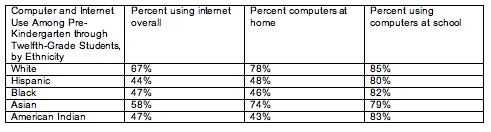
(Source: "Computer and Internet Use by Students in 2003," http://nces.ed.gov/pubsearch/pubsinfo.asp?pubid=2006065)
Virtually all U.S. schools are connected to the internet. Here in Pennsylvania, it is a goal to connect all High Schools by the year 2009. “Data from national surveys suggest that although American schools have more microcomputers than those of any other country, the level of access is still insufficient…” [SRI] What is essential is to provide students the opportunity to develop effective technology skills. This however requires a high volume of up-to-date technology which is difficult given the strain on technology budgets and the constant rate at which technology changes. The technology director plays a critical role in ensuring that this is done effectively.
Pennsylvania has taken bold steps with their Classrooms for the Future initiative. However not all schools have reaped the benefits of this grant. In addition, research has shown that although one-to-one computing ratio is not necessary scattered computers and an occasional computer literacy class in the computer lab will not suffice. When considering the allocation of technology in the classroom, “…the practice of putting one or two computers into a classroom appears ineffective…[I]t does seem that something on the order of 6-8 computers (enough for a quarter of the students working individually or half of the class working in pairs) is necessary to provide an environment where access problems are not an impediment.” [SRI]
Technology coordinators facing obstacles of working in a low-income and/or high-minority district can use several strategies to help them reach their technology goals. First, they need a well-defined plan, including a rationale of exactly what, where, and when technology can be used to support the learning process. This plan has to consider what will be purchased, where technology will be placed to reach all students, and what software/activities will be completed with the technology. Equity in quantity and quality must be addressed. Options for reaching those goals, against cultural, economic and equity constraints include actions to:
Gorski suggested that a multicultural education approach to understanding and eliminating the digital divide should include the following. First it should view technology-related inequities in the context of larger educational and societal inequities, understanding that the groups most effected by the digital divide in technology are the same groups historically disenfranchised by curricular and pedagogical practices in general. Therefore it is necessary to examine not only who has access to computers and the Internet, but how these technologies are being used being careful not to promote any program that proposes “more is better”. Anything that claims that it can narrow the divide by providing more computers and more, or faster, Internet access, to a school, library, or other public place is suspect. It is also important to think about "access" not just as the physical access to computers and the Internet but access to support and encouragement to pursue and value technology-related fields.
No matter what district a technology coordinator operates in, it needs to be understood that acquiring technology is only the first step. Quantity and quality have both have to be addressed for equitable access to occur. Staff development and active pursuit of proper student and staff use of technology must follow if educational benefits are to be realized.
References
Becker, H.J. (1992) Equity and the ‘Big Picture’. Accessed January 16, 2007 from URL http://www.technos.net/tq_01/1becker.htm
Becker, H (2000). Who’s Wired and Who’s Not: Children’s Access to and Use of Computers. The Future of Children CHILDREN AND COMPUTER TECHNOLOGY. Vol. 10 •No. 2 Downloaded January 16, 2007 from URL http://www.futureofchildren.org/usr_doc/vol10no2Art3.pdf
Feller, B. (2006). Digital divide still separates students. E-school news online. Accessed January 27, 2007 from URL http://www.eschoolnews.com/news/showStory.cfm?ArticleID=6606
Gorski, P. (2001) Understanding the Digital Divide from a Multicultural Education Framework. Accessed January 28, 2007 from URL http://www.edchange.org/multicultural/net/digdiv.html
Neuman, D. (1991) Technology and Equity. Eric Digest. Accessed January 22, 2007 from URL http://www.ericdigests.org/1992-5/equity.htm
SRI International. Technology and Education Reform: A Research Project Sponsored by the Office of Educational Research and Improvement, U.S. Department of Education. Accessed January 17, 2007 from URL http://www.ed.gov/pubs/EdReformStudies/EdTech/approaches.html
US Department of Commerce. (2000) Falling Through the Net: Towards Digital Inclusion. Accessed January 6, 2007 from URL http://www.ntia.doc.gov/ntiahome/fttn00/Falling.htm#36