Ethernet is a local area network (LAN) which was originally developed by Xerox in 1976. Today, ethernet is the most widely-installed LAN technology. The IEEE 802.3 standard became the official Ethernet standard in 1985. Typically, an Ethernet LAN uses coaxial cable or special grades of twisted pair wires. Ethernet may also be used in wireless LANs. The most commonly installed Ethernet systems are called 10BASE-T and provide transmission speeds up to 10 Mbps. Devices are connected to the cable and compete for access using a Carrier Sense Multiple Access with Collision Detection (CSMA/CD ) protocol.
Fast Ethernet or 100BASE-T allows for transmission speeds up to 100 megabits per second. Fast Ethernet is typically used for LAN backbonesystems, supporting wokstations with 10BASE-T cards. When an even higher level of backbone support is available, gigabit Ethernet provides speed of 1000 megabits per second (1 gigabit or 1 billion bits per second) and 10-Gigabit Ethernet provides up to 10 billion bits per second.
Hubs
A hub is a central hardware component in a star topology. They can also be used to expand any local area network. In hub based topology, wiring can be changed or expanded as needed, different ports can be used to accommodate a variety of cabling types, and network traffic can be monitored centrally.
Hubs vs Switches
Hubs and switches both connect nodes in a network, but they do so in different ways.
An Ethernet switch works at layer two (data-link layer) of the OSI model and automatically divides the network into multiple segments. It acts as a high-speed, selective bridge between the segments, and supports simultaneous connections of multiple pairs of computers. When the switch receives a packet, it reads the destination address from the header information in the packet, establishes a temporary connection between the source and destination ports, sends the packet on its way, and then terminates the connection. Therefore computers are not competing with other pairs of computers for network bandwidth.
Repeaters
For some organizations, the limitations of 10Base2 and 10Base5 cabling systems are unacceptable. If longer distance limits, more computers, more fault tolerance, or the ability to combine different cabling systems is needed, repeaters can be added to the network.
A repeater is a device that works on the physicial layer of the OSI model by taking all data packets it receives from one Ethernet segment and repeats them, on another segment. It takes the incoming electrical signals, translates them into binary code, and then retransmits the electrical signals. Repeaters address the need for more computers, greater distances, improved fault tolerance, and integration of different cabling systems, but cannot do anything to deal with the downside of these larger networks: increased traffic. Repeaters are not smart devices—they repeat every data packet they hear, regardless of its origin. Because the repeater repeats all packets that hit the wire, without regard to the source or destination, the rules of CSMA/CD apply to the entire network as a whole. If two computers on two different segments connected by a repeater both transmit a packet at the same time, a collision will result. Thus using repeaters to build larger networks can lead to traffic jams, meaning more traffic and slower overall performance.
Bridge
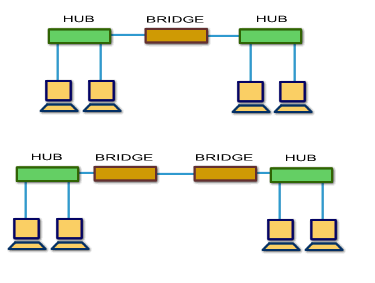
A bridge is a device used to connect two local area networks. It allows workstations from either LAN to access resources from the other. Like switches, bridges work on the data-link level of the OSI model. Network administrators like to use bridges because they are simple to install, flexible, and relatively inexpensive. A Bridge works at a higher OSI level than a repeater, they also accomodate more nodes so they provide better network performance. They can use routing tables to reduce traffic by deciding what packets get forwarded.
Gateway
A gateway enables communication between networks using different protocols. They typically operate at the Application layer of the OSI model by repackaging and converting data so that the networks can communicate. On a network, gateways are usually dedicated server therefore they are often considered expensive and slow.
Complex networks need a device that can determine the best path for data. Routers work on the network level (third level) of the OSI model. They can switch and route packets over multiple networks. When a router revieves a data packet, it looks at the Layer 3 source address to determine an appropriate path for that data. They know the address of all the systems on the network, and also know the addresses of the bridges and routers on the network.
In a server based network, data and file sharing can be centrally administered and controlled. It allows for sharing of printers and applications while maintaining security for the user. The administrator is responsible for setting the policies and applying them to every user. Regularly scheduled server backups provide security as well.
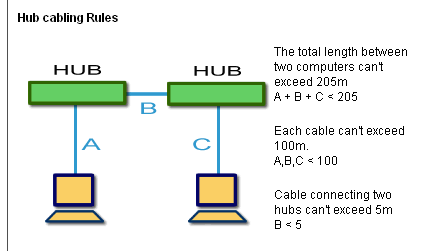 A hub is a central hardware component in a star topology. They can also be used to expand any local area network. In hub based topology, wiring can be changed or expanded as needed, different ports can be used to accommodate a variety of cabling types, and network traffic can be monitored centrally.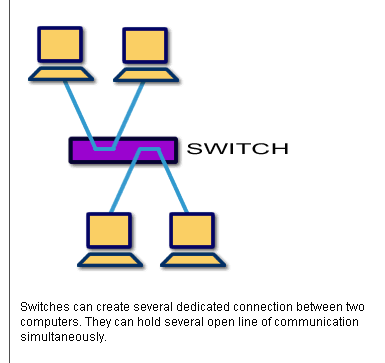
 Bridge